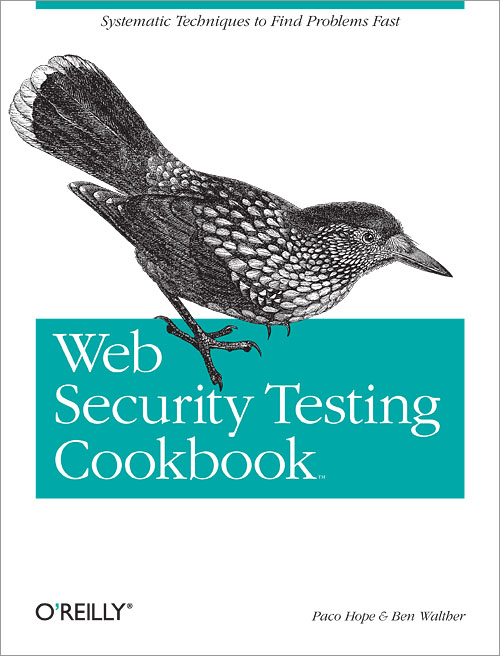
Livre numérique Web Security Testing Cookbook
Systematic Techniques to Find Problems Fast
Télécharger
Incluant :Version liseuse / tablette - ePub
Version Amazon Kindle - Mobipocket
Version imprimable - PDF
Version web
Détails
| Contributeurs : | Paco Hope (Auteur), Ben Walther (Auteur) |
| Publication : | 17/10/2008 |
| Langue : | English |
| Pages : | 320 |
| Éditeur : | O'Reilly Media |
| ISBN : | 978-0-596-51483-9 |
| ISBN Ebook : | 978-0-59615-588-9 |
Description
Among the tests you perform on web applications, security testing is perhaps the most important, yet it's often the most neglected. The recipes in the Web Security Testing Cookbook demonstrate how developers and testers can check for the most common web security issues, while conducting unit tests, regression tests, or exploratory tests. Unlike ad hoc security assessments, these recipes are repeatable, concise, and systematic-perfect for integrating into your regular test suite.
Recipes cover the basics from observing messages between clients and servers to multi-phase tests that script the login and execution of web application features. By the end of the book, you'll be able to build tests pinpointed at Ajax functions, as well as large multi-step tests for the usual suspects: cross-site scripting and injection attacks. This book helps you:
- Obtain, install, and configure useful-and free-security testing tools
- Understand how your application communicates with users, so you can better simulate attacks in your tests
- Choose from many different methods that simulate common attacks such as SQL injection, cross-site scripting, and manipulating hidden form fields
- Make your tests repeatable by using the scripts and examples in the recipes as starting points for automated tests
Don't live in dread of the midnight phone call telling you that your site has been hacked. With Web Security Testing Cookbook and the free tools used in the book's examples, you can incorporate security coverage into your test suite, and sleep in peace.
Accès
| Ressource | Format | Protection |
|---|---|---|
| Tous supports | ||
| Version imprimable (PDF) | PDF : format lisible avec un lecteur compatible PDF, tel Adobe Acrobat Reader®, dont la dernière version, entièrement gratuite, est accessible sur le site Adobe. | Aucun : le fichier est tel que déposé par l'éditeur, aucune protection n'est appliquée. |
| Version liseuse / tablette (ePub) | EPUB : Format basé sur XHTML (le format de texte majoritairement utilisé sur le Web), et donc théoriquement lisible sur tous types de périphériques, grâces à de nombreux logiciels de lecture, souvent disponibles gratuitement. Attention : ce format est souvent verrouillé par le système d'Adobe dit « DRM ». Dans ce cas, seul Adobe Digital Edition® (version gratuite disponible sur le site Adobe), et quelques logiciels agréés permettent de déchiffrer ces fichiers. Nous indiquons les fichiers non-verrouillés par un petit « smiley » jaune. | Aucun : le fichier est tel que déposé par l'éditeur, aucune protection n'est appliquée. |
| Version web | Streaming : format vous permettant d'accéder en streaming aux ouvrages via notre liseuse web. Pour accéder à ce format, vous devez impérativement disposer d'une connexion à l'Internet et d'une largeur d'écran supérieure à 800 pixels. Actuellement compatible avec Firefox 3 ou supérieur, Safari 4 et Internet Explorer 7 ou supérieur. | Liseuse en ligne : lecture en ligne seulement. |
| Version Amazon Kindle (Mobipocket) | Mobipocket : format lisible avec le lecteur Mobipocket®, particulièrement pratique pour les appareils mobiles (téléphone), et certains e-reader (cybook et Kindle). Voir le site mobipocket pour plus d'informations. | Aucun : le fichier est tel que déposé par l'éditeur, aucune protection n'est appliquée. |